


The Amalfi Coast: A Gentle Guide to Italy's Cliffside Riviera
Lemon terraces, turquoise water and villages stacked on cliffs. Here is how to enjoy the Amalfi Coast slowly, from boats, buses and terraces instead of staircases.
Some landscapes announce themselves quietly. The Amalfi Coast does not. You come round a bend on the old coast road and the whole thing opens at once: a wall of grey-green mountain dropping straight into water so blue it looks dyed, and villages clinging to the rock in pink, ochre and white, held up by terraces of lemon trees.
This is a fifty-kilometre strip of southern Italy, in the province of Salerno in Campania, just south of the Sorrento peninsula. UNESCO placed it on the World Heritage list in 1997 — not for a single monument, but for the whole hand-made landscape of terraces, mule paths and small harbours wedged beneath the Monti Lattari.
It also has a reputation for being hard work: steps, slopes, hairpin bends. That reputation is fair, and it is also beatable. The trick is not to climb the coast but to float along it and look up. This guide is written for travellers who would rather sit on a boat deck or a shaded terrace than conquer a staircase — and who want to know, honestly, which is which.
A little history
The Romans came first, building seaside villas along these cliffs. But the coast's great age began later, with Amalfi itself: an independent maritime republic from the ninth century, the oldest of Italy's four sea republics, trading with Byzantium, Egypt and Spain and credited with bringing paper-making to Europe. Its ships and its merchants made this unlikely cleft in the mountains rich.
The Normans ended that in 1136, and the coast slipped into centuries of quiet poverty — fishing, lemons, silk, paper mills in the valley behind Amalfi. That poverty is, oddly, why the landscape survived. Nobody built motorways or resorts; people built terraces, held up by dry stone walls, and stone stairways between them.
The modern chapter begins in the nineteenth century, when the corniche road was cut into the rock, and continues with the writers, painters and film crews who arrived in the 1950s and made Positano famous. Walk the coast today and you are walking through all of it at once: a Byzantine-looking cathedral, a medieval garden, a mule path, a lemon grove, and a café terrace built for the view.

The town of Amalfi seen from the water, wedged into its narrow valley.
What to see
Positano
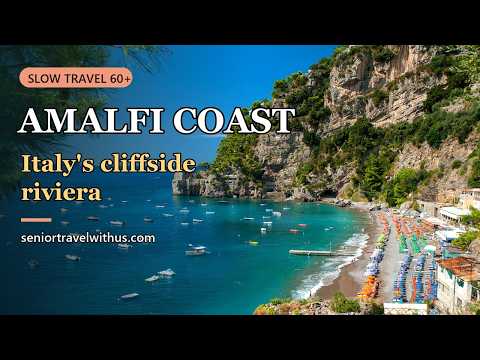
The coast's postcard: a pyramid of pastel houses tumbling to a grey-sand beach, crowned by the majolica dome of Santa Maria Assunta. The honest truth is that Positano is a staircase with a village attached — the main road runs along the top, and reaching the beach means a long descent on steps and steep lanes, then the same in reverse. Many visitors over 60 enjoy it best from the water or from the viewpoints above, and keep their walking to the short, level stretch along the beachfront.
Amalfi and Atrani
Amalfi is the easiest of the famous towns: a flat seafront, a level main square, and the bus and ferry both stopping within a few steps of the centre. Its Cathedral of Sant'Andrea, with striped stonework and bronze doors cast in eleventh-century Constantinople, sits at the top of a grand staircase of sixty-two steps — splendid to look at from a café table if you would rather not climb it. Ten minutes away on foot or by bus, tiny Atrani keeps a village square where locals still outnumber visitors.
Ravello's gardens
Ravello sits high above Amalfi, about a 25-minute bus ride up a spiral of hairpins, and it holds the two finest viewpoints on the coast. Villa Rufolo, a medieval house with Moorish-looking cloisters, is right on the main square and asks for very little walking. Villa Cimbrone is a 10- to 15-minute walk along a narrow pedestrian lane, with steps and uneven paving on the way, and rewards you with the Terrace of Infinity — a balustrade lined with marble busts, about 365 metres directly above the sea. If you can manage one slow climb on this coast, make it this one.
The coast road and the Furore inlet
Between the towns, the road itself is the attraction: tunnels, viaducts, lemon terraces and sudden gaps where the mountain splits open. The best known is the little fjord at Furore, a narrow cleft spanned by a high bridge, with a handful of old fishermen's houses at the bottom. You see it best from the road or from a boat.

The coastline looking from Positano towards Praiano, with headlands fading into the distance.
Gentle walks and the comfortable ways to see it all
By boat — the kindest viewpoint
From roughly April to October, passenger ferries run along the coast between Salerno, Amalfi, Positano and Sorrento, with crossings between Amalfi and Positano taking something like 10 to 25 minutes depending on the boat. There is no better way to understand this landscape: the villages only make sense from the sea, and you are sitting down the whole time. Boarding is by gangway onto a floating pontoon, usually with a crew member's hand to steady you. Small private boats can be hired by the half day from Amalfi, Praiano and Positano, which lets you drift below the cliffs at your own pace.
Easy walks
- Amalfi's Valle dei Mulini — from the top of Amalfi's main street, a paved lane follows the stream inland past the ruins of old paper mills. The first part is gently uphill and shaded; turn back whenever you like. Beyond it the route climbs seriously into the Valle delle Ferriere nature reserve, with ferns and waterfalls, and is best left to confident walkers.
- Minori to Maiori seafronts — both towns are among the flattest on the coast, with level promenades that make for a genuinely easy evening stroll. The famous Lemon Path between them, however, is two to three kilometres of old mule track with several hundred stone steps: lovely, but not gentle.
- Ravello's lanes — the paved, traffic-free walk from the main square towards Villa Cimbrone, taken slowly with pauses, is one of the loveliest short walks in Italy.
- The Path of the Gods — the celebrated clifftop trail runs roughly 8 kilometres from Bomerano, above Agerola, to the hamlet of Nocelle, usually in about three hours. Taken in that direction it mostly descends, but it has uneven, rocky footing, little shade and sheer drops. If you are curious rather than committed, ride up to Nocelle by bus and walk only the first level stretch out of the village for the same view.
A seat with a view
There is no railway along the coast itself; trains reach only Salerno and Sorrento at either end. Instead, the blue SITA buses are the local scenic ride, hugging the cliff edge all the way — spectacular, cheap, and often standing-room-only in summer, so travel early in the day and in spring or autumn if you want a seat. For a calmer version, a hired car with a local driver for a half day costs more but means air conditioning, a seat by the window, and stops at the viewpoints you choose.

On board the ferry between Amalfi and Positano — the easiest way to see the coast.
A day trip nearby
Capri, in season, is the natural excursion: ferries run from Positano, Amalfi and Sorrento, and the crossing is short enough to be a pleasure. The island is well set up for people who do not want to climb. A funicular railway lifts you from the harbour at Marina Grande up to Capri town in a few minutes, and from Anacapri a single-seat chairlift glides slowly up Monte Solaro, the island's summit at around 589 metres, in roughly a quarter of an hour. The view from the top — back across the bay to the Amalfi cliffs — is the finest panorama in the region, and you reach it sitting down.
Pompeii is the other great day out, about an hour from the coast by road via Sorrento or Salerno. Much of the excavated city is walkable on the flat, though the ancient paving is rough and uneven and there is almost no shade; go at opening time, hire a guide, and plan to see one quarter well rather than all of it badly.
Honest advice for comfortable travel
- Choose your base for its gradient, not its fame. Amalfi is the most practical of the well-known towns: flat centre, ferry and bus together, shops and restaurants on the level. Maiori and Minori are flatter still and quieter. Positano and Ravello are beautiful places to visit and demanding places to stay.
- Ask one specific question when booking. "How many steps are there from the road or the port to the room?" Hotels here are built into cliffs; some have lifts cut through the rock, others have eighty steps and a porter. The answer changes your whole holiday.
- Travel in the cooler hours. The coast faces south and the rock holds heat. Sightsee before 11am and after 4pm, and keep the middle of the day for a long lunch under a vine.
- Use the ferry whenever it runs. It replaces the two hardest things on this coast — the winding bus and the uphill walk — with a seat and a breeze.
- Be realistic about driving. The SS163 coast road is narrow, endlessly curved and shared with full-size buses; parking is scarce and expensive. If nobody in your party relishes that, a driver for a day is money well spent.
- Bring shoes with grip. Almost every surface here is polished stone, marble or old paving, and it is slippery when wet.
- Pace the season. November to March is lovely and empty, but many hotels, restaurants and all the ferries close, and rain can be heavy.

Fornillo beach in Positano, reached from the town by a walkway with steps.
What to eat
The coast's cooking is built from three things: the sea, the vegetable terraces, and the lemon. The sfusato amalfitano is a long, thick-skinned, remarkably sweet lemon grown on these slopes, and it turns up everywhere — grated over fish, in limoncello, and above all in delizia al limone, a dome of sponge filled and cloaked in lemon cream that is the region's signature dessert.
For a main course, look for scialatielli ai frutti di mare: short, thick ribbons of fresh pasta, invented in Amalfi itself, with clams, mussels and prawns. Fish cooked all'acqua pazza — simmered in water, tomato, garlic and herbs — is simple and very good. From the fishing village of Cetara comes colatura di alici, an intense amber anchovy sauce made much as the Romans made theirs, served on spaghetti with garlic and parsley. Up in the hills above Positano, Agerola is known for its fior di latte mozzarella.
Eat where the menu is short and in Italian, order the house white from Tramonti or Furore, and leave room for the lemon.
Getting there
| Nearest airports | Naples Capodichino, roughly 1.5 to 2.5 hours to the coast by road depending on traffic and destination. Salerno Costa d'Amalfi, much closer but with a smaller choice of flights. Rome is a long alternative, around 4 hours by road and rail combined. |
| By public transport | Train from Naples to Salerno (about an hour) or to Sorrento, then a seasonal ferry or a SITA bus along the coast. Salerno to Amalfi by bus takes roughly 1 to 1.5 hours; by ferry, around 35 to 70 minutes. |
| By road | The SS163 coast road links all the villages — magnificent, narrow and slow. Allow far longer than the distance suggests, and expect to pay for garage parking. |
| Best months | Mid-May to June, and mid-September to mid-October: warm sea, open ferries, bearable crowds. July and August are hot and very busy; most services pause from November to March. |
| How long to stay | Four to six nights in one place is ideal. Fewer, and you spend it all in transit. |
| Currency | Euro (€). Cards are widely accepted; carry some cash for buses and small cafés. |
Our verdict
The Amalfi Coast has a reputation as a place for the young and sure-footed, and we think that is only half true. Yes, it is vertical, and no amount of planning changes that. But almost everything worth seeing here is a view — and views are generous things. They come to you on a ferry deck, from a bus window, from a chairlift seat, from a marble balustrade in Ravello, from a café table in Amalfi's square with a granita melting in front of you.
So choose a flat base, buy the boat ticket, go in late September when the light turns gold and the water is still warm, and let the staircases belong to someone else. What you will remember is not the climbing you did not do. It is the moment the engine slows off Positano and the whole village rises out of the sea in front of you, exactly as promised.

Positano at dusk, when the lights come on tier by tier above the bay.
“Here the mountains lean out to see the sea, and take the villages with them.”
Photo credits
- Positano Bay: Spenvann, CC BY-SA 4.0 via Wikimedia Commons
- Amalfi vista dal mare 2 Campania: This Photo was taken by Wolfgang Moroder . Feel free to use my photos, but pleas, CC BY-SA 3.0 via Wikimedia Commons
- View from Positano to Praiano at the Amalfi coast 31180428157: Eduard Marmet, CC BY-SA 2.0 via Wikimedia Commons
- Ferry Ride Between Amalfi and Positano 42250218604: Nan Palmero from San Antonio, TX, USA, CC BY 2.0 via Wikimedia Commons
- Positano - Fornillo Beach: Mihael Grmek, CC BY-SA 4.0 via Wikimedia Commons
- Positano at dusk, Amalfi Coast, Italy: Eric Hossinger, CC BY 2.0 via Wikimedia Commons
Watch the video
About this guide: researched from public sources (tourism offices, park and transport websites) and written with the help of AI tools that check key facts before publishing. Prices, opening hours and access can change, so please confirm them with the official source before you travel. Found something out of date? Tell us. How our guides are made.


