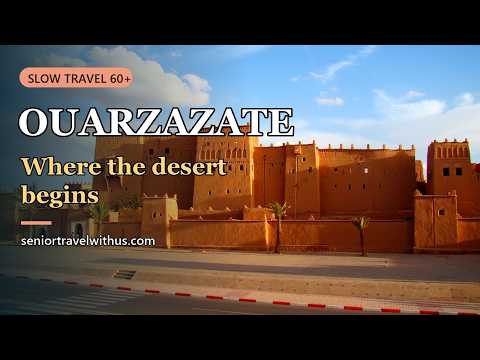
Ouarzazate: A Calm, Level Town Where the Desert Begins
Most travelers treat Ouarzazate as a lunch stop on the way to the dunes. Given two slow days, this flat, easy-walking town is one of southern Morocco's kindest places to rest.
Ouarzazate is the town everyone passes through and almost nobody stops in. Coaches cross the High Atlas in the morning, pause here for a tagine, and press on toward the dunes before dark. From the window it looks like one wide modern road lined with pink-brown buildings, and that is all most visitors ever see of it.
Stay a night, though, and something unusual becomes clear. After the stepped alleys of Chefchaouen and the crowded lanes of the Marrakech medina, Ouarzazate is almost flat. The main street is broad, the pavements are wide, the buildings are low, and the mountains sit politely on the horizon instead of under your feet. For anyone who has spent a holiday negotiating staircases and cobbles, that is not a small thing.
This is a gentle guide to the town itself rather than to the desert beyond it: an old earthen fortress at the end of the avenue, a museum full of film sets, a palm oasis down a bumpy track, and long golden evenings at around 1,150 metres, where the light lasts and the air cools the moment the sun goes down.
A little history
The name is generally traced to Tachelhit, the Amazigh (Berber) language of the region, and is often translated as "without noise" or "without confusion" — a fitting name for a place that still feels unhurried.
Long before there was a town, there was the kasbah. Local tradition holds that Taourirt was first raised in the 17th century by the Imzwarn, a powerful local family. What is better documented is that the Glaoui family took it over and greatly enlarged it in the 19th century. The Glaoua controlled the passes and caravan routes between Marrakech and the Sahara, and the clan's most famous figure, Thami El Glaoui, became Pasha of Marrakech during the French Protectorate. Taourirt was one of the family's southern strongholds: not a castle in the European sense, but a dense honeycomb of rammed-earth rooms, courtyards and stairways where a ruler, his relatives, his servants and his guards all lived stacked together.
The modern town is much younger. It was founded in 1928 as a French garrison post, chosen for its position at the junction of the High Atlas and the pre-Saharan plains, controlling the way into the Drâa and Dadès valleys. That military origin explains the grid of straight, generous streets — and it is exactly why Ouarzazate is so easy to walk today.
The third chapter is cinema. Film crews came for the light, the space and the landscapes; Atlas Studios opened in 1983, and productions from Lawrence of Arabia and Gladiator to Game of Thrones have used the area. Today Ouarzazate is a provincial capital of around 80,000 people that quietly lives half in the 17th century and half on a film set.

A Glaoui kasbah in Ouarzazate, built in the rammed earth of the region.
What to see
Ouarzazate's sights are few, close together and unhurried. Two half-days is plenty, and you never need to rush.
Kasbah Taourirt
The old Glaoui fortress stands at the eastern end of Avenue Mohammed V and is the reason to come. From outside it is a great sculpted cliff of earth, with tapering towers and geometric patterns pressed into the walls — best seen in the last hour before sunset, when the mud turns apricot. A restored palace section is open to visitors: reception rooms with painted cedar ceilings, carved plaster, coloured window grilles, and a tall shaft of daylight dropping through a central skylight. Beyond it, whole quarters stand unrestored and roofless, which is oddly moving. Guides wait at the entrance and are genuinely useful here, as the layout makes little sense without one.
The Cinema Museum
Directly across the open square from the kasbah entrance, the Cinema Museum fills a former studio compound with sets, thrones, props and painted backdrops left behind by productions. It is dusty, cheerfully unpolished and entirely at ground level — a good choice on a hot afternoon or if you would rather not climb the kasbah stairs.
Atlas Studios
A few kilometres north-west of the centre, Atlas Studios offers guided walks among standing sets: Egyptian temples, Roman streets, aeroplane fuselages baking in the sun. The tour is mostly flat but almost entirely unshaded, so go early in the day. A taxi from town takes only a few minutes.
Avenue Mohammed V and the craft shops
The avenue is the town's spine, with cafés, pharmacies, banks and a cluster of co-operative shops selling carpets, silver and saffron. There is no medina maze to get lost in and no pressure to match Marrakech's; shopkeepers here are notably relaxed.
Kasbah Tifoultoute
About 8 km west of town, this smaller Glaoui kasbah sits above the Ouarzazate river valley. It is a short, pleasant drive and a lovely place for a mint tea with a view over the palms, especially in late afternoon.

The entrance courtyard of the restored palace section of Kasbah Taourirt, with the Cinema Museum entrance across the square.
A day trip nearby
Aït Ben Haddou
About 30 km north-west of Ouarzazate — roughly 30 to 45 minutes by road — the fortified village of Aït Ben Haddou rises from the far bank of the Ounila river. It has been a UNESCO World Heritage Site since 1987 and is the most photographed earthen settlement in Morocco.
Be honest with yourself about the walk. The full route climbs from the riverbed through steep, uneven lanes to a ruined granary at the summit, and it takes most people well over half an hour each way, in full sun, with rough steps and few railings. The good news is that you do not have to do it. The lower lanes, the potters' workshops and the views from the riverbank give you most of the magic on the flat, and a vehicle track reaches the village side, so a driver can drop you much closer than the main car park. Ask before you set out.
Fint Oasis
Closer to home, the palm oasis of Fint lies only about 12 km south of town, but the last stretch is a rough unpaved track and the trip takes roughly 45 minutes each way in a sturdy vehicle with a local driver. The reward is a green ribbon of palms and small villages below dark stony hills, where families serve tagine and mint tea. It is a delight — but the jolting road is genuinely hard on backs and necks, so skip it if that is a concern.
The road itself
East of town the landscape opens into the Skoura palm groves and then the Dadès valley; north-east, rows of mirrors from the vast Noor solar complex catch the light in the distance. This is a working power station rather than a visitor attraction, but it makes a striking sight from the road.

An abandoned kasbah in Ouarzazate Province, of the kind that dots the valleys around the town.
Honest advice for comfortable travel
- The town is refreshingly flat. Ouarzazate was laid out on a grid, so there are no stepped alleys and no hills in the centre. Pavements are wide, though kerbs and the occasional broken slab mean a walking stick is more useful than wheels.
- Stay on or just off Avenue Mohammed V, ideally toward its eastern end. From there the kasbah, the Cinema Museum, cafés and pharmacies are all a short, level stroll, and you avoid taxi trips for every small errand. Hotels with a garden and shaded terrace are worth the extra.
- Inside Kasbah Taourirt there are stairs — many of them. They are narrow, earthen, uneven and sometimes without a handrail, doorways are low, and there is no lift. The courtyard, the walls and the exterior views are wonderful on their own, so visit without guilt if climbing is not for you, and tell your guide at the start how much you want to do.
- Time your days around the sun. Mornings until about 11 and late afternoons from around 4 are the comfortable hours. July and August daytime highs commonly approach the high 30s Celsius, and the air is extremely dry: carry water, a hat and sunglasses, and drink more than you think you need.
- Bring warm layers in winter. At around 1,150 metres, December to February days are pleasant in the high teens Celsius, but nights can fall close to freezing. Confirm that your room has real heating.
- The mountain drive deserves respect. The road from Marrakech crosses the Tizi n'Tichka pass at roughly 2,260 metres, with long stretches of tight bends. If you are prone to motion sickness, sit in front, break the journey at Aït Ourir or Taddert, and allow a full day rather than racing it.
- Use petits taxis freely. They are inexpensive, plentiful and ideal for the 2 km hop from the airport or a run out to Atlas Studios. Agree the fare or ask for the meter before setting off.
- Services are good for a small town. As a provincial capital, Ouarzazate has pharmacies, banks, cash machines and a hospital — reassuring if you are heading further into the desert afterwards.
- Carry some cash. Cards work in hotels and larger shops, but small cafés, co-operatives and taxis are cash-only.

Kasbah Taourirt seen from the west; the surrounding streets are level and easy to walk.
What to eat
Southern Moroccan cooking is slow, mild and very easy on the digestion — good news if rich food troubles you.
Tagines are the heart of it: chicken with preserved lemon and olives, lamb with prunes and almonds, or vegetable tagines heaped with carrot, courgette and potato, all cooked gently under a clay lid and eaten with bread rather than cutlery. Harira, a tomato and lentil soup, is the standard evening warmer. Couscous is traditionally a Friday dish, so ask which day it is being served.
Breakfast is a quiet pleasure: msemen and harcha pancakes with honey and olive oil, fresh bread, jam, white cheese, and glasses of sweet mint tea. Look for Berber omelette, cooked in a tagine dish with tomato and onion, and for kefta — spiced minced-meat skewers grilled over charcoal.
The Drâa valley oases nearby are date country, and you will find dates and almonds sold loose in the shops along the avenue, along with argan oil and saffron from elsewhere in the south. Buy a small bag of dates for the road; they are the best possible travel snack.
Alcohol is served in some hotels and tourist restaurants but is not part of everyday life here, and many places do not offer it. Bottled water is widely available and worth sticking to.
Getting there
| Nearest airports | Ouarzazate (OZZ), about 2 km north of the centre, with domestic flights from Casablanca and a small, seasonal handful of European routes; Marrakech (RAK) is the main gateway, about 200 km away |
| By road | Marrakech to Ouarzazate is roughly 200 km over the Tizi n'Tichka pass, about 4 to 5 hours by car; from Agadir allow 6 to 7 hours; from the Dadès valley or Skoura, 1 to 2 hours |
| Buses and taxis | Long-distance coaches (CTM and Supratours among them) link Ouarzazate with Marrakech, Agadir and the southern valleys; shared grand taxis are quicker but cramped, and hiring the whole car is far more comfortable |
| Best months | March to May and October to November; winter is pleasant by day but cold at night; July and August are very hot |
| How long to stay | 2 nights for the town and Aït Ben Haddou; 3 if you want Fint oasis or a slow day by the pool |
| Currency | Moroccan dirham (MAD); cash for taxis, cafés and co-operatives |
| Altitude | About 1,150 metres, so cool evenings and strong sun all year |

Kasbah Tifoultoute, about 8 km west of Ouarzazate, on the road in from the west.
Our verdict
Ouarzazate will not dazzle you in an hour. It has no blue medina, no tanneries, no famous square. What it has is space, quiet, and a rare kind of ease: a town where you can walk to dinner on the flat, sit outside with a pot of tea while the light turns the mountains rose, and reach a 19th-century fortress and a UNESCO village without a long day in the car.
For travelers over 60 we think that combination is worth more than another hill town. Use Ouarzazate as a two- or three-night rest rather than a refuelling stop — either as your turning point after crossing the Atlas, or as the soft landing before you go on to the dunes. Go in spring or autumn, keep the middle of the day for shade, and let the town do what its name suggests: nothing much, beautifully.
“Between the last mountain and the first dune, a town that has learned the value of sitting still.”
Photo credits
- Kasbah Taourirt in Ouarzazate 2011: Bjørn Christian Tørrissen, CC BY-SA 3.0 via Wikimedia Commons
- Kasbah glaoui ouarzazate morocco: Sierramaik, CC BY-SA 4.0 via Wikimedia Commons
- Kasbah Taourirt Ouarzazate DSCF6838: R Prazeres, CC BY-SA 4.0 via Wikimedia Commons
- Abandoned Kasbah Ouarzazate Province 2: Farajiibrahim, CC BY-SA 4.0 via Wikimedia Commons
- Kasbah Taourirt Ouarzazate DSCF6861: R Prazeres, CC BY-SA 4.0 via Wikimedia Commons
- Morocco, Souss-Massa-Draa Region, Ouarzazate Province, Kasbah Tifoultoute: Vincent van Zeijst, CC BY-SA 3.0 via Wikimedia Commons
Watch the video